William (Bill) Anders was killed on 7 June 2024. The Beechcraft T-34 Mentor he was piloting crashed into the water off the coast of Jones Island, located within the San Juan Islands archipelago in the US Pacific north-west state of Washington. As of this publication date the US National Transportation Safety Board is continuing its investigation of the accident and has issued
a preliminary report.
You probably know little, if anything, about the extraordinary life and times of the 90-year-old deceased pilot; yes, 90. Nevertheless Anders was more than qualified to fly his high performance single-engine World War II era military aircraft, reaching speeds of over 250 knots (288 mph) at 30,000 feet.
There are hundreds of privately owned former military training and fighter aircraft around the world. Pilots need to be physically fit and mentally alert to handle these puppies. Bill Anders was that, and more. With thousands of flight hours logged, he was one of the few who had actually “slipped the surly bonds of Earth” and “danced the skies on laughter-silvered wings.”
He held degrees in electrical as well as nuclear engineering and was the US ambassador to Norway. But before all that Bill Anders was a United States Air Force fighter pilot who retired a major general. He was also a NASA astronaut.
Going to where no human had gone before
On 21 December 1968 Anders, with Frank Borman and Jim Lovell, lifted off aboard Apollo 8 from Florida’s Kennedy Space Center. Apollo 8 would become the first crewed spacecraft to leave Earth’s gravitational influence and, 68 hours and more than 230 thousand miles later, successfully entered Lunar orbit. These men were the first humans to see and photograph the far side of the Moon.
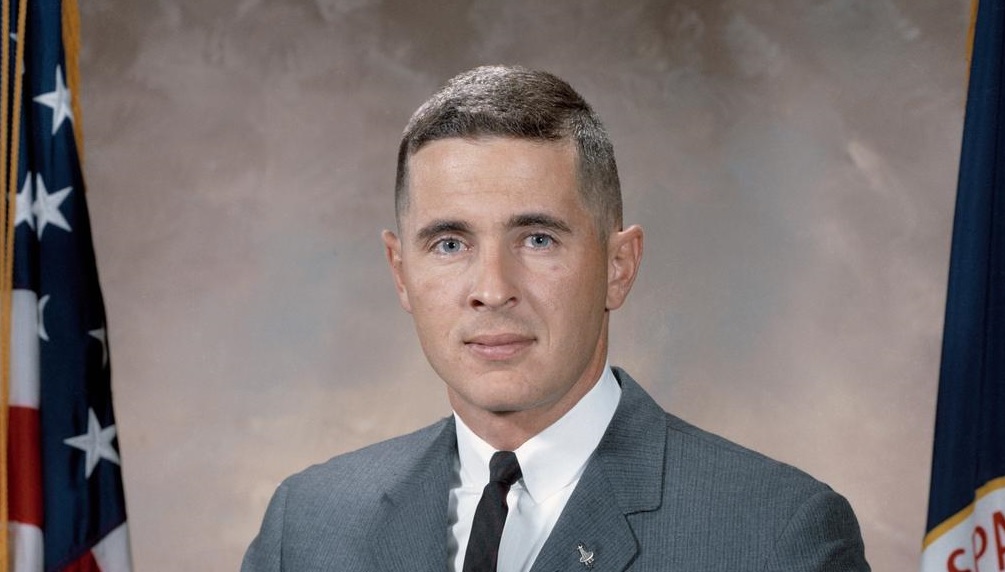
Photograph courtesy NASA
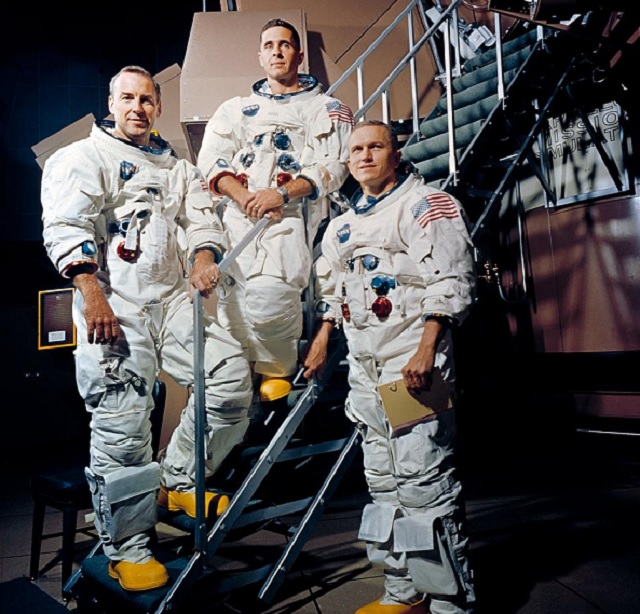
Bill Anders, Frank Borman.
Photograph courtesy NASA
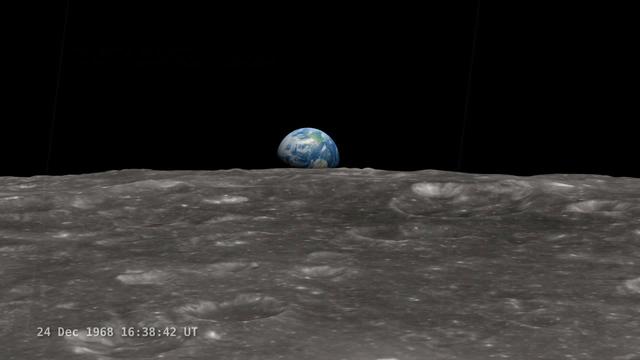
On Christmas Eve 1968 Bill Anders took a photograph that Nature photographer Galen Rowell described as “the most influential environmental photograph ever taken”. The picture eclipsed any of the hundreds taken of the Moon’s surface during the spacecraft’s 20 orbits and gained fame as Earthrise.
Four years later, on 14 December 1972, the last manned mission to the Moon,
Apollo 17, lifted off from the lunar surface. As a pilot who had never flown beyond Earth’s stratosphere, I watched what had come to be a routine launch for the return journey to Earth. I, in company with a small band of pilots and aerospace enthusiasts, were sadly aware this was the last Apollo mission to Earth’s natural satellite.
At the time I honestly believed the US, or another country, would attempt a return to the Moon within a decade. I held true to the hope and vision of +2001: A Space Odyssey, Stanley Kubrick’s 1968 movie adaptation of Arthur C. Clark’s book. That naive and optimistic expectation was slowly chipped away long before the approach of the new century and 2001 itself.
Today, NASA and its commercial partners have scheduled the launch of Artemis II, a manned flight around Earth’s satellite, in the first half of 2026. If all goes fuzzy-warm, a year later Artemis III’s mission profile includes a landing near the lunar south pole; 54 years after Apollo 17 departed the Moon’s Taurus-Littrow valley.
To send humans to Mars is “stupid”
The Moon is but a stepping stone on the inevitable human journey through the solar system – provided we don’t nuke the planet beforehand, ignorantly pass by the last tipping points of climate change, fail to prepare for the mother of all pandemics, or are hit with an extinction event asteroid. Sorry, but these are catastrophes from which not even Gerald Butler or Jason Statham can save us.
Fear not, plans are already afoot for the next great challenge. About 140 million miles from Scotland’s Unst spaceport is Mars, named after the Roman God of war. The Red Planet and its fictitious residents have been the go-to place for a large body of films and books. Few are classics, some are campy and fun to watch or read. The rest are simply crap.
NASA and its commercial partners are chomping at the bit to reach out to Mars and beyond. Why? You would think the brainiacs at NASA, the European Space Agency (ESA), and the Chinese National Space Administration (CNSA) have seen the pictures of the Martian landscapes, courtesy of the multiple rovers.
I appreciate it will take a lot of new science and bold innovative engineering, not to mention creative marketing, to build habitats that’ll make Mars liveable and appealing for future colonists. The sales pitch will have to be more appealing than the El Toro poo-poo Eric the Red told vain Norsemen to encourage migration to Greenland. Even so, I can’t see Mars rating very high on Tripadvisor.
Sending humans to Mars is “stupid” and “almost ridiculous”. Not my words! Bill Anders uttered them when he was interviewed in 2018 on BBC 5 Live celebrating the 50th anniversary of his Apollo 8 mission.
We’re fascinated with Mars and what’s beyond the asteroid belt. Truth be told, we hope our planetary and interstellar probes and radio signals find something akin to Mr Spock, the Doctor or E.T. Try not to think about Independence Day, Klingons or the Borg,
To where no one has gone before
In centuries to come humankind might reach Alpha Centauri, approximately 4.2 light-years from our Sun. The triple star system of Rigil Kentaurus, Toliman, and Proxima Centauri is our nearest neighbour. The exciting fact (to some) is that in 2016 an Earth-size planet that orbits Proxima was discovered and lies in what astronomers boringly call the circumstellar habitable zone. I prefer the metaphor “Goldilocks zone,” in reference to the children’s fairy tale where a delinquent girl instigates a home invasion, breaks furniture, eats their food and crawls expectantly into the offspring’s bed.
At some point beyond tomorrow science and technology will develop an interstellar drive system, one that we cannot conceive of today. This time warping, universe folding, wormhole mode of travel may whisk us to Sirius, the Orion Nebula or Wolf 359 where the Borg kicked Federation arse.
It may take more than a few mortal life times, or perhaps it’ll never come to pass. But it’s possible that somewhere beyond our Sun’s gravitational influence other forms of sentient life exist. Perhaps at this very moment a celestial neighbour, looking up in the direction of our own star system, asks a fellow xenomorph, “Ever wonder if there’s life out there, eh, Bob?”
With respect to NASA, Star Trek, Steven Spielberg and Bob, belief in an extraterrestrial presence is theological, not unlike one’s faith in a particular God, the coming (1st or 2nd) of a Progeny or the evangelical predictions of an Armageddon homecoming.
Assimilated or trampled by four horsemen
Theologians of all faiths and those who herald an extraterrestrial era of enlightenment both seek revelation, communication, salvation and (sadly) vindication. Then again if Darth Vadar, the Borg or Klingon warriors come knocking then all bets are off. Resistance would indeed be futile.
I suspect likewise for a theological visitation. If a spiritual deity makes an appearance I, for one, can only hope – pray? – the occasional reference in the various holy books of a “merciful God” isn’t just column-space fodder or a good sidebar.
What if, as prophesied in endless grade-B sci-fi movies, an intelligent and peace-loving alien race implanted our hairy grunting, bone tossing ancestors with the ability to reach beyond their potential. If returning to this Petri dish we call Earth today, would these alien founders find their grand experiment living in harmony, using logic and reasoning without the trappings of conflict, singing the Orion Nebula equivalent of Kumbaya? Dream on E.T.! Their report would read: “a species that has become overtly vain and potentially self-destructive, disrespectful and ignorant of the life sustaining ecosystem and other animals, wasting intellectual and creative abilities. Recommendation: quarantine.”
Then again, “Imagine,” in John Lennon’s words, “there’s no Heaven [… ] above us, only sky.” What if Terran bipeds are a unique sentience and the only intelligent life form of its kind throughout the Milky Way galaxy? Gag me with a spoon. Scary thought, eh? The alternative would be that life flourishes throughout the galaxy and we’re the equivalent of Alabama. That might explain why extraterrestrials haven’t attempted to visit us.
Reality can be terrible and sobering
Mankind has been to the Moon. We can start the SUV, open the garage door or change TV channels with a wireless remote. Tunnel vision types will point to the Internet and proclaim it has shrunk the world, opened multiple channels of communication and knowledge for all – not to mention grooming, trolling, disinformation and bad grammar. Thanks to the world wide web we can surf volumes of knowledge, attain university degrees and work from home while naked.
As Mr Spock would say: “Fascinating.”
Read online news headlines or watch the all-news-all-the-time channels streamed into your home. What we are living is light years from “fascinating”!
Sadly, after squandering more than seven millennia not everyone has decent shelter. Not all regions of the planet produce or process enough food to ensure children don’t go to bed hungry. From ancient times to this day women and girls have faced inequality and subjugation be it in the poorest villages or corporate towers. Education and health care is more or less accessible – albeit more so in affluent countries. Then again many G20 countries also face severe hardship. Slavery and human trafficking was common in the days of the Pharaohs and Caesars just as it is today
Since early man we have continued to quarrel over bits of land, whether it’s Gaza, Ukraine or the Falkland Islands. Children in Ethiopia and Edinburgh go to bed hungry. Even before the Scythians, who were feared for their use of poisoned arrows, no expense has been spared to develop and deploy horrific weapons to defend the realm, even if it results in innocents being used as cannon fodder or mutual assurance destruction (MAD).
All the while the core fundamentals of human rights and decency – freedom of thought, assembly and speech, access to quality health care, education, a clean environment, food and housing – are debated to ad nauseam by political masters with one agenda: the preservation and continuing betterment of the politico-bureaucratic-economic elite.
It’s no wonder people want to get off this rock.
Before colonising we need to fix our home
It is arrogant to assume other species are not out there. It is equally frightening to be faced with the possibility that humanity might be the sole seed carrier for sentient life throughout this galaxy. Then again, being an arrogant self-centred creature we may also fail to recognise or ignore other highly sentient lifeforms. We shouldn’t expect these lifeforms to be biped and similar to humans as depicted in most sci-fi flicks.
Before colonising the planets and moons of this solar system we first need to cure the ills of our planet, its millions of species, and the environment. It may take another century or two. We need to clean up our act here, before going to Mars, the moons of Jupiter, beyond the Oort Cloud and Kuiper Belt to the nearest star system.
Earthrise
Bill Anders’ comments about not sending astronauts to Mars didn’t mean he wanted us to give up on exploring other worlds beyond our own. He did advocate sending probes and rovers to the planets and their moons, perhaps even going as far as hitching a ride on visiting comets or asteroids.
To send men to the Moon in 1968 and bring them safely back to Earth was a technological and scientific risk and achievement. Seeing the Moon so close was exciting (for me). On that Christmas Eve, I was in a room with a new colour television watching a live NASA broadcast from Apollo 8, seeing the Moon’s surface in one of its windows.
Then we saw it, rising above the Moon’s horizon, surrounded by the black canvas of empty space, Earthrise; looking so small and fragile, our home, our only biosphere.
Much later, after returning to Earth, Bill Anders said:
“We came all this way to explore the Moon, and the most important thing is that we discovered the Earth.”
This article was also published in Bylines Scotland
 iscribe
Leave a comment